Start with the place your business actually serves
Write down why you want a local number before choosing three digits. If you mainly serve nearby customers, an area code associated with that market is a reasonable starting point. If clients are spread across the US, a stable number you can keep may matter more than a particular city’s prefix.
| Your situation | Start with | Check next |
|---|---|---|
| A business serving one local market | The geographic area you actually serve. | Official coverage, current inventory and your accurate business details. |
| A solo freelancer with clients nationwide | Your home business market or an existing consistent contact identity. | Calling workflow, renewal costs and long-term access. |
| A business expanding into another market | An area associated with customers you can actually support. | Service hours, supported calling destinations and truthful location information. |
| Your preferred code has no search results | Other in-service codes covering the same area, where an overlay exists. | NANPA coverage and a fresh inventory search for each alternative. |
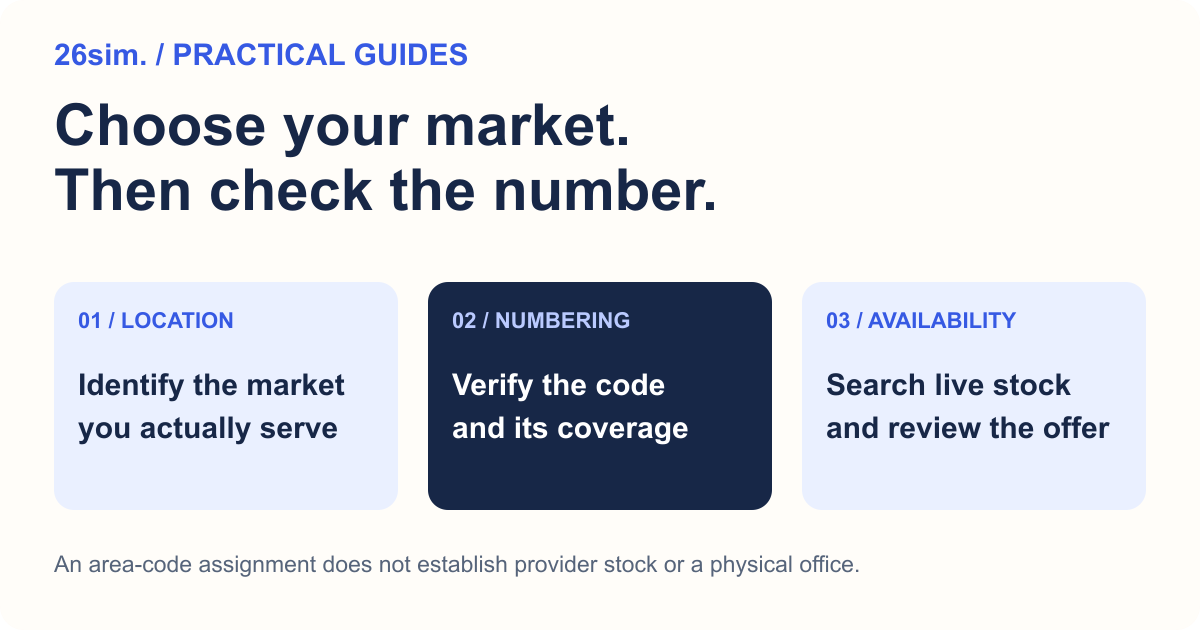
Understand country code, area code and local number
NANPA describes a North American Numbering Plan number as ten digits: a three-digit Numbering Plan Area code, commonly called the area code, followed by seven local digits. In international form, the number starts with +1 before those ten digits.
The +1 calling code covers the US, Canada and other participating countries and territories. It does not identify a US number by itself. Confirm the country assignment and area code rather than selecting any number beginning with +1.
NANPA publishes separate reports for geographic and non-geographic codes. For a US local business number, use the geographic coverage information. A toll-free or other non-geographic service needs a separate feature and pricing comparison.
Check overlays when your first choice is unavailable
An overlay means more than one area code serves the same geographic area. This can give you another code to investigate without choosing a different market. Use NANPA’s current area-code search and geographic reports to check which codes are in service and where they apply.
Do not assume that a newly announced code is already usable. NANPA lists planned codes separately from in-service codes. An official assignment or implementation date also does not establish that a particular provider has a number available for you.
If your preferred code returns no inventory, try a verified in-service overlay where one exists, retry later or ask support about alternatives. Empty search results describe that search, not every provider’s stock.
Search and check a 26sim US local number
- 01
Choose the US local-number offer
Open the US number options or the homepage US plans. Confirm whether the selected offer is available before continuing.
- 02
Enter the three-digit area code
Use the area-code field in the US number picker. Check that the returned number matches the intended country and code.
- 03
Review the complete service
Confirm rental, usage, renewal, eligibility, call routing and messaging requirements. An area code cannot tell you which features a number supports.
- 04
Activate and test before advertising
Search results do not reserve numbers. Confirm supplier provisioning, then test an incoming call, callback and any required SMS workflow before publishing.
Keep geography separate from service features
An area code describes a numbering assignment. It does not show where a person is physically answering or certify that a business has an office there. Describe your business location and service area accurately wherever you list the number.
For current 26sim US monthly plans, incoming calls forward to a verified existing US phone. Callbacks start from the private dashboard and connect supported US destinations. Incoming SMS appears in an online inbox; outgoing SMS requires registration approval. MMS and mobile data are not included.
A local-looking number does not guarantee that a caller’s plan treats a call as free, that a verification app accepts the number or that a listing ranks higher in search. Choose the service on verified requirements rather than expecting the prefix to supply those outcomes.
Choose a number you can maintain
Before adding the number to a website or printed material, review monthly renewal, usage funding and cancellation. Keeping the same published number requires keeping its service active. Released numbers may not be recoverable.
Current 26sim website ordering does not support number porting. If you already advertise another number, do not cancel it in anticipation of a transfer through the website. Ask support about your requirements before changing public contact details.
Numbering references for this guide were checked on October 31, 2026. They establish numbering context, not current stock or eligibility for an individual order.
Separate a state, a city and its actual numbering footprint
A state-name search is a starting point, not a three-digit assignment. New York State is much larger than New York City; California has several distinct coastal and inland numbering areas; Texas includes separate Dallas, Fort Worth, Houston and far-western footprints. Match the community you genuinely serve to the official boundary before checking a live offer.
The examples below were checked against current NANPA records, its maps and the cited implementation/state-regulator material on November 6, 2026. They are selected reference points, not a complete code list for each state or proof of inventory. Some connected code groups have different underlying boundaries: NYC’s shared 917 does not make Manhattan and the outer boroughs identical.
For example, northern Orange County’s 714/657 association is different from greater Sacramento’s 916/279. Likewise, Dallas uses 469 and 972 among its overlay codes; similar-looking digits are not substitutes. Use the original full contact when calling someone, and the exact locality/rate center when requesting a new assignment.
- If you live elsewhere, distinguish a remote contact number from eligibility to buy and use it. Current 26sim US voice still requires an existing supported verified US phone; a local foreign SIM or a laptop alone is not that connection.
- A local-looking contact does not establish an office, improve a search ranking by itself or guarantee that friends pay no long-distance charge. State your actual location and service area accurately.
- Include the full area code when publishing an ordinary US contact. Conventional dialing can require ten digits or 1 plus ten depending on the originating service; use the particular regional guide and carrier instructions.
- Confirm ordinary voice, approved SMS direction, renewal and the receiving phone before printing materials. Current 26sim does not include MMS or mobile data, and a directory entry does not reserve an assignment.
| Place you actually mean | Codes to investigate | Boundary or implementation check |
|---|---|---|
| NY: Manhattan Zone 01 | 212, 332, 646 and relevant 917 assignments | Outer-borough 465 is not a blanket Manhattan overlay. |
| NY: Bronx, Brooklyn, Queens, Staten Island and Marble Hill | 347, 465, 718, 929 and relevant 917 assignments | 465’s earliest activation was June 18,2026; specific assignment and stock remain separate. |
| TX: Dallas numbering region | 214, 469, 972, 945 | Fort Worth’s separate 817/682 area should not be merged into this list. |
| TX: Austin region | 512, 737 | Greater Austin footprint, not every central Texas community. |
| TX: Houston region | 281, 346, 621, 713, 832 | 621 overlays the existing region; January 23,2025 implementation is not a retail-stock guarantee. |
| TX: El Paso region | 915 | Use the Texas map for the specific far-western footprint; it is not an alternative Dallas code. |
| TX: San Antonio region | 210, 726 | Official coverage includes all or parts of named communities, not every surrounding county. |
| CA: central Los Angeles region | 213, 323, 738 | Not all Los Angeles County. 738 entered service November 1,2024. |
| CA: San Francisco and surrounding assigned territory | 415, 628 | Includes most Marin and a small San Mateo portion; does not cover all Bay Area contacts. |
| CA: predominantly northern Orange County | 714, 657 | Includes all or parts of places such as Anaheim and Santa Ana; not the whole county and not Sacramento. |
| CA: greater Sacramento | 916, 279 | A separate territory including Sacramento, Elk Grove, Folsom and other named communities. |
| CA: San Diego 619/858 territory | 619, 858 | The old boundary was removed; do not infer all San Diego County uses this group. |
| CA: San Jose and surrounding assigned territory | 408, 669 | Primarily Santa Clara with parts of Alameda and Santa Cruz; verify an exact boundary address. |
Common questions
Does +1 mean a phone number is in the United States?
No. The North American Numbering Plan shares +1 across the US, Canada and other participating countries and territories. Confirm the area code’s assignment and the country shown in the offer.
Can two area codes cover the same place?
Yes. An area-code overlay adds another code serving the same geographic area. Check NANPA’s current geographic and planned-code reports before treating an alternative as available for use.
Can I choose any area code on 26sim?
The US picker can search by area code, but results depend on live supplier inventory and the offer. Searching does not reserve a number or guarantee activation.
Does a local area code prove I have a local office?
No. A numbering assignment does not prove a physical business location. Keep your location and service-area information accurate on your website and listings.
Will a particular area code make my business rank higher?
This guide does not establish a search-ranking benefit from any prefix. Choose by genuine service area, availability, customer contact needs and the complete offer.
Can I choose a Texas, New York or California number while living elsewhere?
First verify the actual customer eligibility, available assignment and usable voice route. A state or city prefix is not evidence of residence or a local office. Current 26sim US calling requires the existing supported verified US phone; it does not turn a foreign SIM or a browser into that phone.