Compare the service behind the number
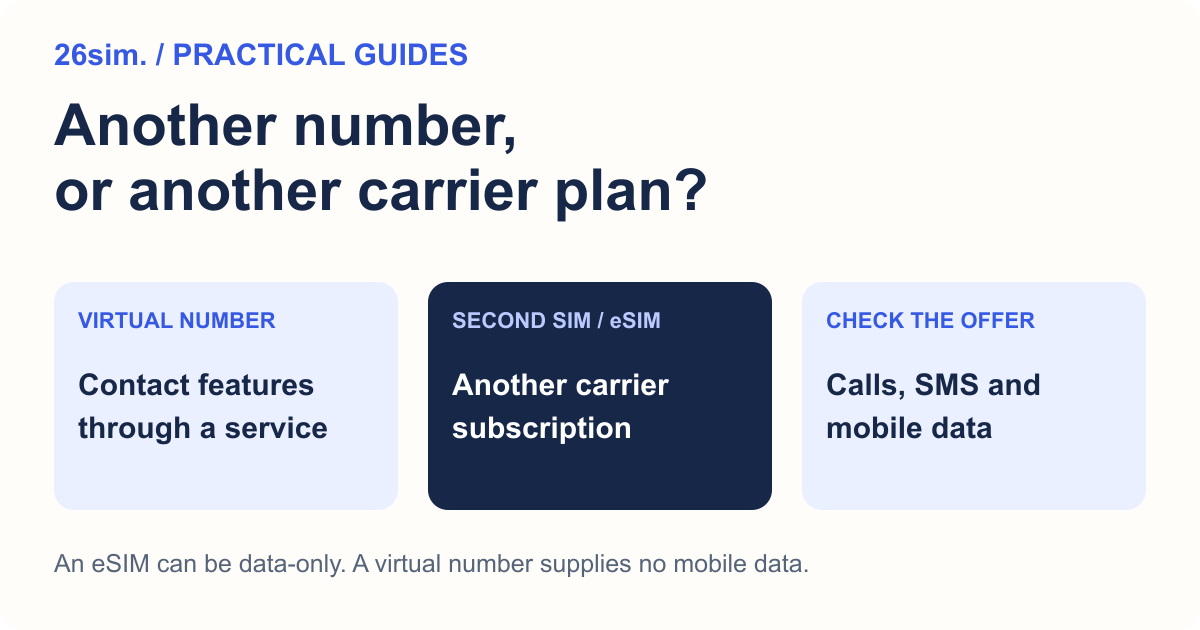
The word “eSIM” describes a digital SIM, not a particular bundle of calls, messages or data. A carrier voice plan and a data-only travel plan can both use eSIM technology. Check what the specific plan includes rather than assuming an eSIM always gives you a second telephone number.
Likewise, “virtual number” does not describe one universal calling experience. A provider may deliver calls in an app, through forwarding or through another supported setup. The table compares the general models; individual offers determine the actual features.
| What to compare | Virtual-number service | Second SIM or eSIM carrier plan |
|---|---|---|
| What you add | A number with provider-defined calling or messaging features. | A carrier subscription; included voice, messaging and data depend on the plan. |
| Device setup | App, browser inbox or forwarding, depending on the service. | A compatible device and carrier support for the additional line. |
| How calls arrive | Through the provider’s app or configured forwarding route. | Through the carrier line, subject to device and network features. |
| Messages | Check incoming SMS, outgoing approval and MMS separately. | Check the plan’s supported message types and charges. |
| Mobile data | The number itself supplies no mobile data. | Available only when the carrier plan includes it. |
| Ongoing cost | Rental, usage, registration and any additional fees. | Carrier plan, usage, roaming and any additional fees. |
Which option fits your situation?
| Your situation | Option to investigate | Deciding question |
|---|---|---|
| A freelancer with a working phone wants another public contact number | A virtual-number service | Can you receive calls, make callbacks and handle messages through its actual workflow? |
| You want another cellular line on a compatible phone | A second SIM or eSIM carrier plan | Does the device and carrier support the extra line and the calls, SMS and data you need? |
| You mainly need internet access while travelling | A travel data plan | What coverage, data allowance and duration are included? A virtual number supplies no mobile data. |
| Several staff need a shared business contact point | A service with explicit team features | Are shared access, routing and business hours included? Neither a number nor a SIM guarantees them. |
Compare a virtual number when contact separation is the goal
Suppose you already have a working mobile plan and want a separate number for a small business website. Your main requirement is a different public contact point. A virtual-number service may fit if its calling route and message features match how you work.
Ask where each conversation takes place. Can you answer calls in an app, or must you have another phone number that receives forwarded calls? Do texts appear in the phone’s usual message app or in a separate inbox? How do you return a call using the business number?
For 26sim US plans, calls use a verified existing US phone. Incoming calls forward to that phone, and click-to-call rings it before connecting a supported US destination. Incoming SMS appears in the private online inbox. This is not a browser softphone or an additional cellular connection.
Compare a second carrier line when you need cellular service
If your requirement is another carrier subscription on your phone, investigate a second SIM or eSIM plan. Check device compatibility, carrier restrictions, coverage and the included services before buying. Apple’s Dual SIM guidance explains using separate business and personal lines and checking carrier support.
Two lines do not mean every device handles simultaneous calls in the same way. Ask your carrier what happens when one line is busy, which line supplies mobile data and whether Wi-Fi Calling affects availability. Check the instructions for your exact model rather than copying another phone’s setup.
A separate carrier line also does not automatically create a business phone system. If you need shared access, opening hours or routing between team members, compare those features explicitly. Choose the line for the service you require today and the workflow you can maintain.
Price the same workflow on both options
List the calling and messaging you expect in one month, then price that same activity on each offer. Compare the total with any extra carrier costs caused by forwarding or receiving calls. Low rental does not necessarily mean low total cost for a busy line.
For a 26sim example, Basic with 50 billed call minutes and no SMS is $4.49: $2.99 rental plus $1.50 in calls. Premium is $6.99 with those minutes inside its 100-minute allowance. These examples exclude taxes, separately quoted fees and any charges under your existing carrier plan.
Also check message requirements. 26sim outgoing SMS requires registration approval, and MMS is unsupported. If you regularly need customers to send pictures, compare a service that explicitly supports that workflow. Do not substitute a cheaper plain-SMS offer and assume pictures will work.
Use these questions to make the choice
Choose only after you can explain how an incoming call, a callback and a message will work. Those three everyday tasks are a more useful buying test than the product label alone.
A tablet can be a place to open a supported web dashboard or read an available online inbox. That does not make it the voice endpoint for every virtual number. Current 26sim US forwarding and callback still need the existing verified US phone; giving a tablet microphone access does not add browser audio. Check the actual device, browser and offer rather than treating this explanation as a tablet compatibility test.
- Need mobile data or an additional carrier connection? Compare carrier plans and device support.
- Need a separate public number on an existing phone? Compare virtual-number calling and inbox workflows.
- Need to answer without an existing phone line? Check for an actual app-based calling service; 26sim US calling requires a verified existing US phone.
- Need pictures, international contact or shared team access? Confirm each feature in the exact offer.
- Need verification codes? Confirm the destination service’s rules; neither a plan label nor SMS capability guarantees acceptance.
- Need to keep an advertised number? Verify transfer support before ending the existing service.
Check standby, active connections and the busy-line behavior
Two installed subscriptions are not a promise that two ordinary calls can stay connected together. DSDS means Dual SIM Dual Standby; DSDA means Dual SIM Dual Active. Qualcomm describes the latter as concurrent cellular connections on different subscriptions. The modem capability, finished phone, software, carrier and selected features all matter. A chipset announcement is not confirmation that your handset implements every simultaneous-use feature.
Apple’s current two-nano-SIM guide, for example, describes DSDS and one mobile data network at a time. Receiving a call on the other line while already talking can depend on that line’s Wi-Fi Calling support and the allowed data route. Without the required support, that line’s call can go to carrier voicemail. Do not turn this device-specific explanation into a rule for all dual-SIM phones.
Before moving a work contact to a second line, label each subscription and choose the default voice and data lines. Check whether data switching is enabled and what it can charge. With a consenting helper, test a call to line B while line A is busy, then reverse the test. Check voicemail and missed-call behavior separately. Use ordinary numbers, not emergency services, for this check.
For travel, a data-only eSIM still does not acquire voice or SMS just because the handset has another working line. Confirm which subscription pays for data during a call and which remains reachable. Carrier forwarding is another possible feature to investigate; it is not automatically included by the words “dual SIM.”
A laptop SIM supplies a connection, not proof of a telephone dialer
A compatible cellular laptop can use a physical SIM or supported eSIM with the necessary data plan and modem. Microsoft’s Surface instructions configure the cellular internet connection. That connection can carry a supported calling app’s traffic, but the SIM slot alone does not promise ordinary telephone voice, an included callable number or microphone audio through any website.
Identify the route before buying. An independent computer calling service must explicitly support the account, destination and computer audio. A phone-linked route uses another device’s service: Microsoft’s Phone Link calling instructions, for example, require Bluetooth between the compatible PC and phone. That is different from a laptop SIM independently placing the telephone call.
Current 26sim US dashboard callback is another distinct route. Starting it from a laptop still rings the existing verified US phone first; that phone carries your side of the call. The dashboard can show incoming SMS, but it supplies neither mobile data nor browser audio. If the laptop must be your only voice device, choose an offer that actually supports that endpoint rather than assuming the SIM or dashboard provides it.
Common questions
Is a virtual number an eSIM?
No. A virtual number is handled through a provider’s service. An eSIM is a digital SIM used for a carrier plan on a compatible device. The calling, messaging and data included in either offer must be checked separately.
Does a second eSIM always include a phone number?
Do not assume it does. Check whether the carrier offer includes voice and SMS or is a data-only plan. The eSIM format itself does not specify the services in the subscription.
Can I keep using my existing SIM with 26sim?
26sim US calling uses your verified existing US phone, so the number service does not replace that carrier connection. Confirm that your existing plan can receive the required calls and check any carrier charges.
Which option is cheaper for a small business?
Compare the same expected usage, required features and additional fees. A low-usage virtual number may have a lower rental than another carrier plan, but that is not a universal total-cost comparison.
Can I use a tablet instead of the phone needed for calls?
A suitable tablet browser can let you manage a usable dashboard, but it does not replace the existing verified US phone required for current 26sim forwarding and callback. Microphone access alone does not add browser audio. Confirm your actual device and service requirements.
Does dual SIM mean I can answer two calls simultaneously?
Not necessarily. Check DSDS or DSDA, the actual model, carriers, Wi-Fi Calling and data settings. Test the other line while one is busy; two installed subscriptions do not guarantee two concurrent voice conversations.
Can a SIM card in my laptop replace the phone needed for 26sim calls?
No. A compatible laptop’s cellular data connection is separate from telephone voice. Current 26sim US forwarding and callback require an existing verified US phone; the laptop dashboard is not its audio endpoint.