What is an SMS segment?
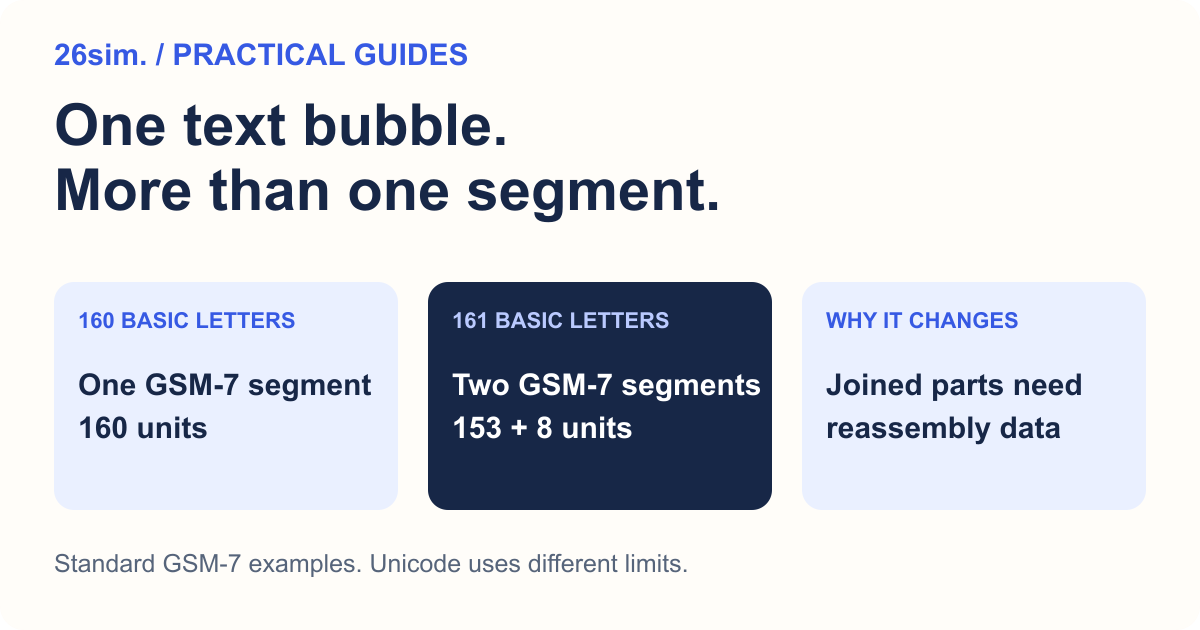
A segment is one part of a text transmitted over SMS. When a longer message needs several parts, the receiving phone normally joins them into one visible message. Your conversation view can therefore show one bubble while the service records two or more segments.
A single SMS has a limited data capacity. When messages are joined, each part also carries information telling the receiving device how to reassemble it. That leaves less room for text in every part. This is why 161 basic GSM-7 letters use two segments containing 153 and 8 letters, rather than 160 and 1.
Compare GSM-7 and Unicode capacity
GSM-7 includes basic Latin letters, digits and a defined set of other characters. Some characters, including the curly braces and euro sign, use an extension and consume two GSM-7 units. If text contains a character outside the GSM-7 repertoire, it generally switches the entire message to Unicode encoding, often described as UCS-2 in SMS documentation.
For Unicode messages, count UTF-16 code units rather than visible symbols. Many common letters and Chinese characters use one unit each, while many emoji use two. A displayed emoji can also be a sequence of several characters. A screen’s visible character count is therefore not enough to predict segments.
| Encoding | One segment | Each part when more than one segment is needed |
|---|---|---|
| GSM-7 | 160 encoding units | 153 encoding units |
| Unicode / UCS-2 terminology | 70 UTF-16 code units | 67 UTF-16 code units |
Worked examples: long text, smart quotes and emoji
These examples describe exact repeated characters so you can reproduce the count. A means the plain Latin capital letter A; 中 is one Chinese character using one UTF-16 unit. Quotation marks in the descriptions are explanatory, not added to the sample.
The usage column applies the current 26sim US Basic rate of $0.02 per segment. It is also the extra-usage rate after the Premium SMS allowance is exhausted. Monthly rental and separately quoted registration fees are excluded.
| Sample text | Encoding and units | Segments | Usage charge |
|---|---|---|---|
| 160 copies of A | GSM-7: 160 units | 1 | $0.02 |
| 161 copies of A | GSM-7: 161 units | 2 | $0.04 |
| 70 copies of 中 | Unicode: 70 units | 1 | $0.02 |
| 71 copies of 中 | Unicode: 71 units | 2 | $0.04 |
| 79 copies of A followed by one smart opening quote (“) | Unicode: 80 units | 2 | $0.04 |
| 79 copies of A followed by one straight quote (") | GSM-7: 80 units | 1 | $0.02 |
| 69 copies of A followed by 🙂 | Unicode: 71 units; the emoji uses two | 2 | $0.04 |
| 80 copies of the euro sign (€) | GSM-7 extension: 160 units | 1 | $0.02 |
| 81 copies of the euro sign (€) | GSM-7 extension: 162 units | 2 | $0.04 |
Convert conversation habits into a monthly estimate
For current 26sim US plans, Basic has no included SMS allowance. Premium includes 100 SMS segments per paid billing month, shared across incoming and outgoing messages. Extra segments cost $0.02 each. Unused segments do not roll over and cannot be exchanged for call minutes.
For example, 40 outgoing messages of two segments each plus 30 incoming messages of one segment each total 110 segments. The SMS usage charge is $2.20 on Basic or $0.20 above Premium’s 100-segment allowance, in addition to the relevant rental and any call usage.
Outgoing registration approval is still required even when an allowance or prepaid credit is available. The text’s content and encoding affect segment usage; they do not establish sending eligibility or delivery.
Check your message before sending
Some providers offer automatic character replacement, such as Twilio Smart Encoding. Do not assume that a generic provider feature is enabled in your 26sim workflow. These examples assume the text is transmitted as written.
Check a draft’s SMS segments
Preview standard local-number encoding and the estimated 26sim US Basic usage charge. This tool does not send a message.
- Encoding
- GSM-7
- GSM-7 units
- 161
- Estimated segments
- 2
- Basic usage estimate
- $0.04
Estimates exclude rental, taxes and registration fees. Premium’s remaining SMS allowance applies first. No automatic character replacement is assumed. Route limits, multipart boundaries and provider processing can affect the recorded count; your dashboard’s final usage is authoritative.
SMS capacities and route exceptions · Estimate your monthly total
- 01
Draft the complete message
Include the real greeting, link, reply instructions and sign-off. Count the final text, since a shortened draft can hide an extra segment.
- 02
Inspect encoding and segment count
Use a segment preview tool. Look for copied smart quotes, extension characters and emoji; a simple visible-character count can miss them.
- 03
Edit for clarity
Remove unnecessary repetition and use plain punctuation where appropriate. Preserve the recipient’s language, necessary meaning and any required instructions.
- 04
Compare the recorded result
After an authorised test, check the dashboard’s recorded segment count. Use actual counts from message history when estimating ongoing costs.
Know which service the examples describe
These examples explain ordinary SMS on US local monthly numbers. Temporary-SMS orders use a separate service and price. MMS and messaging apps use different transport rules; current 26sim US plans do not support MMS.
Twilio documents exceptions for US/Canada toll-free multipart SMS: 152 GSM-7 units or 66 Unicode units per part. The table above uses the standard local-number capacities, not those toll-free exceptions. Maximum message length and delivery limits can also vary by route and service.
The technical sources were checked on October 31, 2026. An encoding calculation estimates segmentation; your dashboard’s recorded count is the reference for actual usage. SMS capability does not guarantee acceptance by a verification app.
Common questions
Why was one text counted as two SMS segments?
The message may have exceeded the single-segment capacity or included characters that switched its encoding. Joined segments appear as one bubble on many phones. Inspect the exact text and the recorded segment count.
Does every emoji use one character of SMS space?
No. Many emoji use two UTF-16 code units, and some visible emoji consist of several characters. They also generally switch a GSM-7 message to Unicode, reducing the capacity for the entire text.
Do spaces and punctuation count?
Yes. Spaces and punctuation use encoding space. Some punctuation uses GSM-7 extension units; smart quotes can switch the message to Unicode. Preview the complete text rather than counting only letters.
Does Premium include 100 text messages?
Premium includes 100 SMS segments shared across incoming and outgoing traffic per paid billing month. It does not promise 100 visible messages: one message can use several segments.
Does shortening a message guarantee delivery?
No. Segment size and delivery are separate issues. Outgoing approval, the active number, supported destinations and service restrictions still apply.