One prefix across three present-day territories
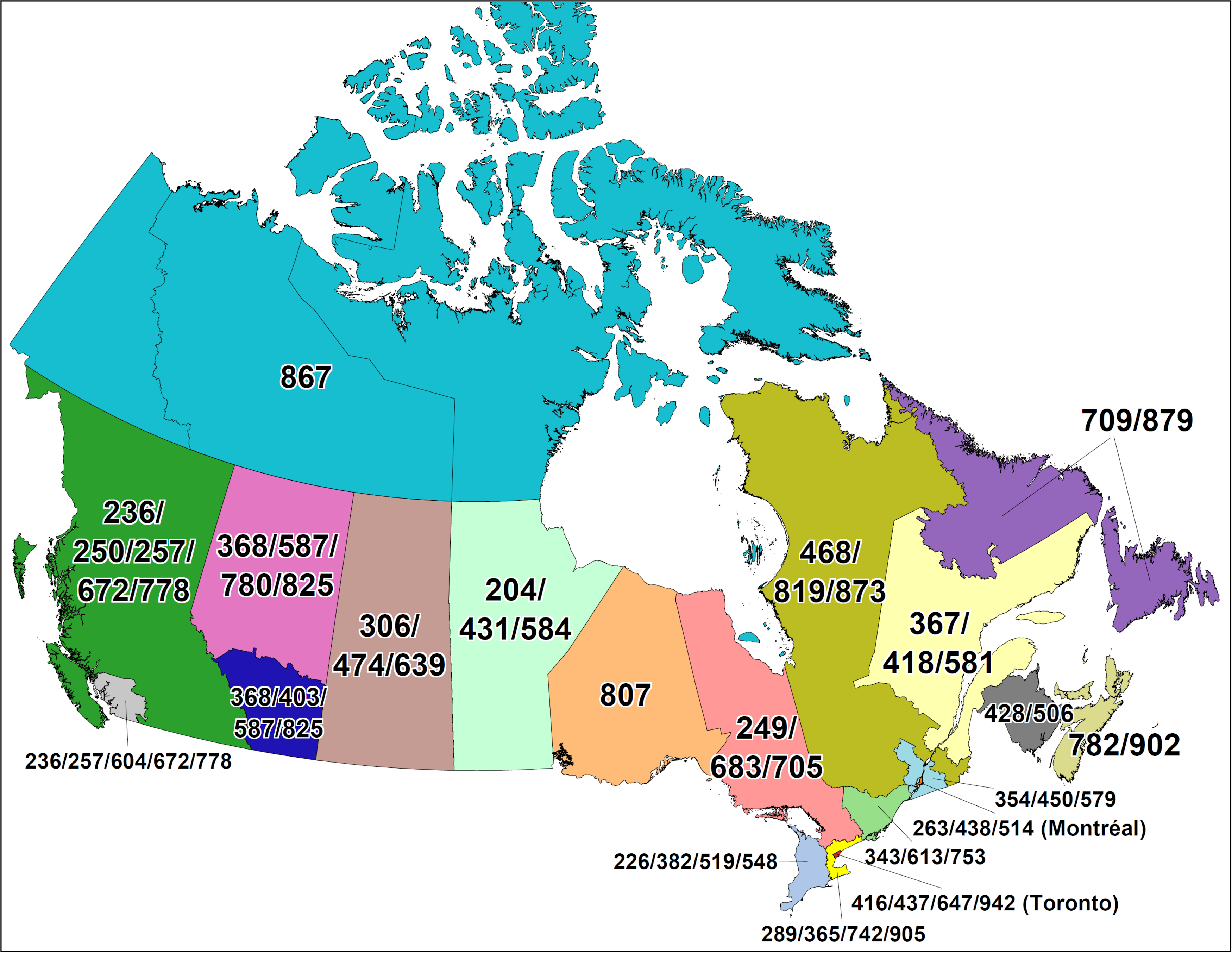
The CNA map places 867 over the northern territorial region. Today that includes Yukon, the Northwest Territories and Nunavut. Whitehorse, Yellowknife and Iqaluit therefore cannot be distinguished simply by the area code; save the full municipality and address with the telephone contact.
Planning Letter 13 introduced 867 on October 21, 1997 for the northern region previously using portions of 403 and 819, with the historical permissive period ending in April 1998. That describes the numbering change at the time; it should not be rewritten as though today’s territorial administrative arrangement already existed in precisely the same form.
A retained or forwarded 867 number does not locate the answering person. For a territorial service enquiry, ask which office or community handles the request, then agree the actual local date and time. A single generic offset for every 867 contact would be misleading.
The Northwestel exception is specific, not universal
The CRTC’s 2022-234 decision approves Northwestel’s use of both seven- and ten-digit local dialing on a permissive basis in 867 outside the Yellowknife local interconnection region, or LIR. Within that LIR, ten-digit local dialing is mandatory. The decision names Yellowknife, Behchoko, Dettah and Whati when describing that region.
This is a provider-qualified regulatory permission. It is not proof that every current 867 mobile service accepts seven-digit entry, that every northern carrier uses the same procedure, or that a call outside the local area becomes local. The decision separately discusses wireless providers’ ten-digit dialing practice.
The December 2022 correction, 2022-234-1, corrects paragraph 132 while retaining the 867 exception outside the Yellowknife LIR. It does not repeal the operative Northwestel permission in paragraph 131. Read the original and correction together rather than treating a national ten-digit headline as the whole rule.
No fresh provider-wide network test is claimed here. If using a particular Northwestel line, mobile service or office system, confirm the current outgoing instructions for that exact service. A voicemail page asking for a ten-digit mailbox identifier concerns mailbox access; it does not establish the general outgoing local-call procedure.
| Situation | What the official policy establishes |
|---|---|
| Northwestel within the Yellowknife LIR | Mandatory ten-digit local dialing |
| Northwestel outside that LIR in 867 | Permission for both seven- and ten-digit local dialing on a permissive basis |
| Another carrier or a mobile service | Do not infer its current procedure from Northwestel’s exception |
| Voicemail mailbox identifier | A separate access instruction, not an ordinary outgoing dialing rule |
Publish a complete contact even where local entry is permissive
For a public directory or a contact shared across Canada, keep the full area code and subscriber number. In an international address book, store +1 followed by the ten digits. A permitted local seven-digit entry on one provider’s line is not a good reason to publish an incomplete number for callers using other services or origins.
Toll dialing is a separate question from the local exception. Follow the outgoing carrier’s applicable 1-plus-ten-digit procedure and verify the destination’s tariff. A shared +1 country code does not guarantee that a territorial Canadian call is included on a US account.
For a government, supplier or community-office enquiry, obtain the full number from the current official page and record which office handles the issue. Keep extensions separate from the main public number. If an unexpected caller requests payment or a code, verify the request through that established channel rather than trusting a familiar 867 display.
- 01
Identify the office
Record the full community, territory and department, not just the prefix.
- 02
Check the originating service
Use its actual local or toll instructions; do not extend another provider’s exception to your line.
- 03
Agree the return contact
Supply a full callback number and a time tied to the real office location and date.
Do not confuse a Canadian lookup with US product availability
A current exchange assignment does not identify a subscriber, establish their location, prove retail stock or guarantee eligibility for a new account. Ask a Canadian-capable provider about the actual exchange, number control, renewal and required voice or messaging features.
26sim’s current US voice offer requires an existing verified supported US phone (excluding Alaska’s 907 and Hawaii’s 808) and uses forwarding or phone-first callback. It does not promise Canadian calling or audio inside the dashboard. Initial activation requires verified email ownership, manual payment/end-user/intended-use review and supplier activation; payment alone does not make the line live. Choose a service explicitly supporting the Canadian function rather than inferring it from shared +1 numbering.
Common questions
Does every 867 customer have to dial the same way?
Do not assume that. The CRTC permits Northwestel seven- and ten-digit local dialing outside the Yellowknife LIR, with ten digits mandatory inside it. Confirm the current instructions for the actual provider and service, particularly mobile or office systems.
Did the 2022 correction remove the Northwestel exception?
No. Decision 2022-234-1 corrects paragraph 132 while retaining the outside-Yellowknife 867 exception; it does not repeal the permission in paragraph 131 of the original decision.
Does a ten-digit voicemail identifier prove ten-digit outgoing dialing?
No. A mailbox identifier is an access credential format. It is not evidence of the ordinary outgoing local dialing procedure for every line.
Does 867 tell me whether a caller is in Yellowknife, Iqaluit or Whitehorse?
No. The region spans the territories, and a retained or forwarded number can be answered elsewhere. Verify the full office contact and actual appointment location.
Are calls from the US automatically domestic because 867 uses +1?
No. Check the outgoing provider’s Canadian destination permission and tariff. Shared numbering does not establish an included calling allowance.