Understand brand, campaign and number association
In this context, an application includes the service or dashboard that sends messages for you. A conversation typed by a person in a business dashboard can still use an application-originated route. Twilio’s US local-number messaging uses A2P registration even for low-volume or individual use.
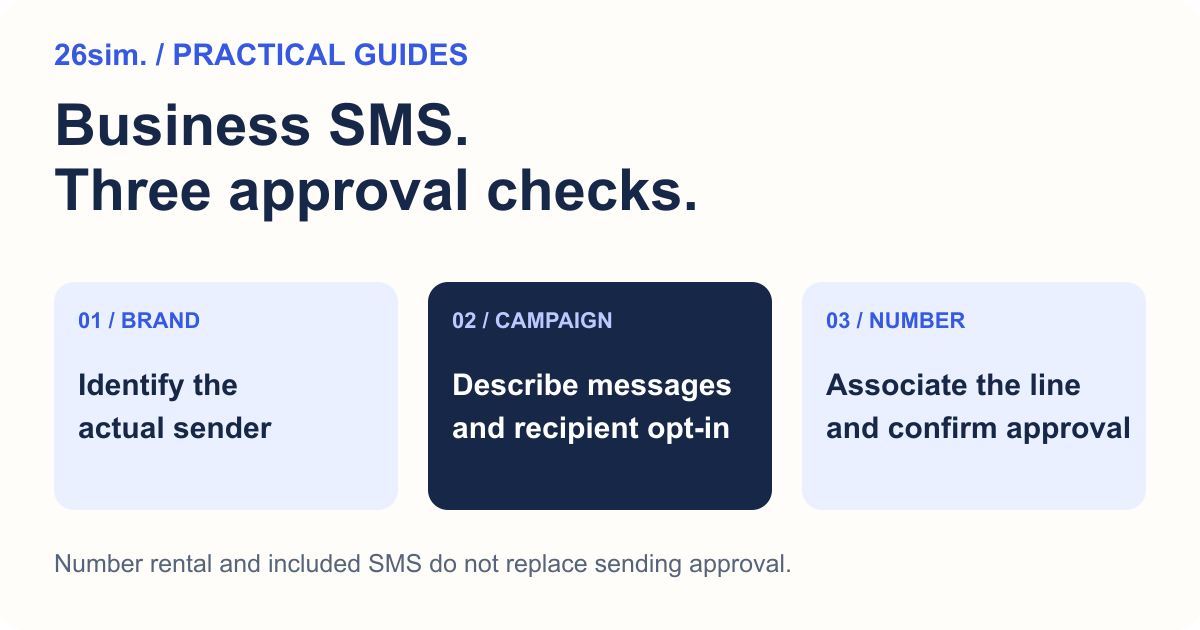
Registration has several distinct parts. Understanding which part is complete is more useful than a general statement that an account is verified.
| Part | What it establishes | What still needs checking |
|---|---|---|
| Brand | The identity of the business or eligible individual sender. | The specific campaign and sending number. |
| Campaign | The use case, example messages and how people agree to receive them. | Approval status and the correct number association. |
| Number association | Which sending number belongs to the approved setup. | An active line, supported recipients, funding and recipient permissions. |
Prepare information that matches the real business
Start with the information your provider asks for, using a consistent business name, contact details and public website. The registration route depends on the sender’s circumstances. A sole proprietorship with an EIN follows a different brand route from an eligible proprietor without one; let support confirm the correct category.
Describe how recipients request messages and what you intend to send. Keep the description consistent with your website and the actual customer experience. If an appointment form collects the permission, explain that form; if another documented flow is used, describe that flow accurately.
- Prepare the legal or business identity details appropriate to the confirmed registration route.
- Identify an authorized contact who can complete any required verification.
- Provide the relevant website and the actual place where recipients opt in.
- Draft representative messages with the business identity and purpose clear.
- Describe how recipients request help and stop further messages.
- Keep sensitive registration documents within the provider’s designated private process.
Make the campaign description specific enough to review
Consider an illustrative bicycle-repair business. Customers ask for repair-status texts when handing over a bicycle. A sample update could read: “Example Cycle: your repair is ready for collection. Reply HELP for assistance or STOP to opt out.” This fictional example explains message purpose; it is not a complete registration application or a template that guarantees approval.
The provider needs to understand how a customer agreed to these updates and how that agreement is recorded. A generic description such as “we send messages to customers” leaves important questions unanswered. Sending a different type of message from the described use case can also require review.
Registration approval does not supply permission from each recipient. Keep messaging within the agreed purpose and respect opt-outs. A short recipient list or a small allowance does not remove those responsibilities.
What to expect before sending through 26sim
This guide does not promise a universal approval time. Allow for requests to correct or clarify information and confirm the actual status before advertising an SMS reply service.
- 01
Confirm the intended use with support
Describe your business, US recipients, expected volume and message purpose. Confirm that the current service supports the workflow you want.
- 02
Review the complete fee quote
Registration can involve setup and recurring charges. Support confirms the applicable fees separately before agreement; number rental and usage prices do not include an unspecified registration fee.
- 03
Supply the requested information
Use the confirmed private process for documents and identity details. Keep the campaign description, sample messages and opt-in process consistent.
- 04
Wait for the required approvals and number association
A paid rental or an approved brand by itself is insufficient. Support records confirmed outgoing approval for the specific number before the dashboard permits sending.
- 05
Send a permitted test and check its status
Use a supported recipient who has agreed to receive it. Confirm line eligibility, available allowance or credit, delivery status and the working reply path.
Keep permission, funding and message support in view
For current 26sim US plans, incoming messages appear in the private online inbox. Outgoing messages need the approved setup, an eligible active line and available SMS allowance or prepaid credit. A recipient’s STOP-family opt-out suppresses further sending to that recipient.
Approval does not add MMS, international destinations or app-verification acceptance to the offer. It also does not make delivery certain for every attempt. Read a message’s actual status and contact support before replacing a request that remains under provider review.
This article concerns US local ten-digit-number messaging. Toll-free messaging uses a separate verification process, so changing the prefix is not a way to assume registration checks disappear. The provider references were checked on November 3, 2026.
Common questions
Do I need registration for a small number of texts?
For the current Twilio-powered 26sim US local-number workflow, outgoing SMS requires approval even at low volume. Ask support about the appropriate route for your use case.
Does brand approval mean my number can send immediately?
Brand identity is one stage. The campaign, sending-number association and 26sim outgoing approval must also be confirmed, along with an active line and sufficient funding.
Does receiving SMS require outgoing registration approval?
Receiving and sending are separate capabilities in the 26sim US dashboard. An activated number can receive SMS while outgoing approval is still pending.
Can Premium bypass registration because SMS is included?
No. Premium’s allowance pays for eligible usage; it does not approve the sender or campaign. Registration and any agreed fees remain separate.
Will approval guarantee delivery?
No universal delivery guarantee follows from registration. Supported routes, carrier handling, line status and recipient permissions still matter for each message.